





The Editor Zambia
When President Hakainde Hichilema declared that his approach to governing Zambia was methodical, some of his critics were quick to dismiss the statement.
They mistook caution for weakness, careful planning for indecision, and a deliberate approach to national problems for an inability to act decisively. 
Yet, with the benefit of experience, it is increasingly clear that being methodical is precisely what Zambia needs after years of governance that too often resembled chipantepante, a colloquial expression for doing things haphazardly, without adequate planning or consideration of the consequences.
Apart from the country’s founding President, Kenneth Kaunda, whose administration operated within a different historical context, Zambia’s subsequent political leadership has too often been associated with hurried decisions, policy reversals and short-term political calculations.
The result has sometimes been the pursuit of immediate political applause at the expense of long-term national development.
President Hichilema came into office promising a different philosophy. He understood that repairing an economy burdened by debt, restoring confidence among investors, and rebuilding public institutions could not be accomplished through presidential declarations or overnight miracles. Such challenges demanded planning, discipline, patience, and consistent execution.
That is why President Hichilema repeatedly insists that his administration is methodical rather than magical. He recognises that national transformation requires one step to follow another, with decisions informed by evidence and guided by clearly defined objectives.
His approach was evident in the time he took to convene his first Parliament after assuming office in 2021. Critics questioned the pace, but the President appeared determined to establish his administration’s direction rather than rush into governance merely to satisfy expectations of immediate political spectacle.
The same philosophy is visible in his second term. President Hichilema’s decision to appoint only four Cabinet ministers, while retaining Mulambo Haimbe for the demanding Foreign Affairs portfolio through presidential nomination, illustrates his emphasis on efficiency, specialisation and the proper deployment of talent.
The message is significant. The government is not necessarily more effective because it has a large
Cabinet, numerous officeholders, or a crowded political establishment.
What matters is whether those entrusted with responsibility possess the competence, discipline, and commitment to deliver results.
In President Hichilema’s thinking, the number of passengers does not determine the speed or direction of a vehicle. Equally, filling government positions simply to accommodate political interests does not automatically translate into better governance.
A smaller, focused, and accountable team can achieve more than a bloated administration in which responsibilities overlap and public resources are consumed by unnecessary bureaucracy.
His advice to Mulambo Haimbe not to contest a parliamentary seat while serving as Foreign Affairs Minister provides another illustration of his thinking.
The President argued that the demands of international diplomacy require sustained attention and that combining them with constituency obligations could compromise one responsibility or the other.
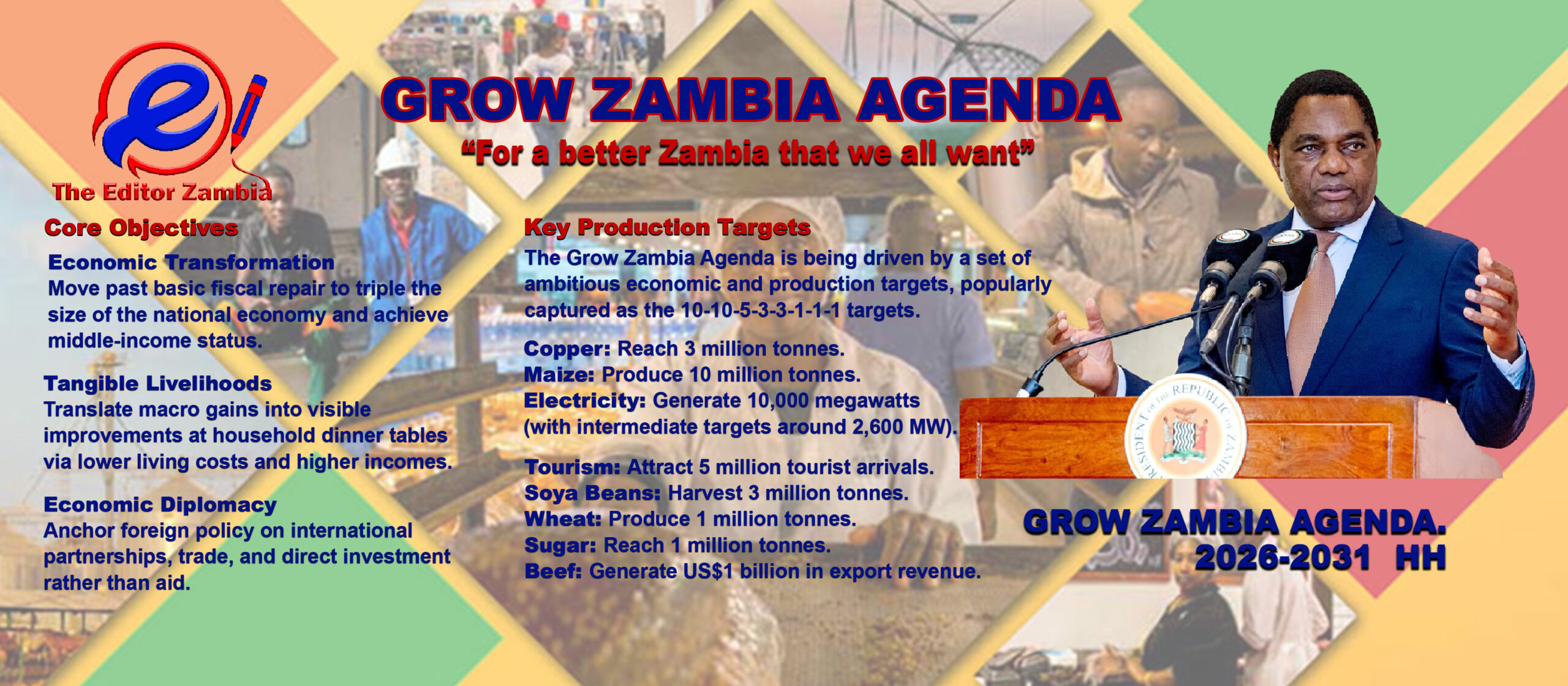
President Hichilema’s methodical philosophy is also reflected in the administration’s long-term Grow Zambia Agenda, which sets ambitious targets for agriculture, electricity generation, tourism, copper production, and other productive sectors.
Such objectives require planning, investment, coordination, and regular monitoring rather than improvised interventions whenever a crisis emerges.
President Hichilema’s governance style challenges Zambia to reconsider its expectations of leadership. A president should not be judged by the number of people surrounding him, the frequency of dramatic announcements, or the speed with which policies are unveiled.
He should be judged by the quality of his decisions and their lasting impact on the country.
Zambia has paid a heavy price for decisions made without sufficient preparation. It is, therefore, refreshing to have a president who insists that the country’s problems must be approached systematically.
In the final analysis, good governance is not a race to announce the most policies or appoint the largest number of ministers. It is the disciplined process of identifying national priorities, allocating resources wisely, and delivering sustainable outcomes.
That is the essence of being methodical. And, if Zambia is to build a stronger economy and more effective public institutions, this is a governing philosophy worth defending.


