







The Editor Zambia
The Zambian Government’s cancellation of six passports on national security grounds has generated debate about the extent to which the State can restrict the movement of its citizens in the name of protecting the country.
Government Gazette Notice No. 1421 of 2026, published on September 11, cancelled the passports of Emmanuel Mwanamba, Emmanuel Jay Banda, Binwell Mpundu, Kaiser Zulu, Sishuwa Sishuwa, and Lillian Mutambo. 
The notice, dated September 7, states that the passports are no longer valid for identification, travel, or official purposes and directs relevant authorities not to recognise them.
Those holding the documents have been instructed to surrender them to the appropriate authorities.
The development is best understood against the broader international reality that national security has long been regarded by governments as a legitimate basis for restricting travel.
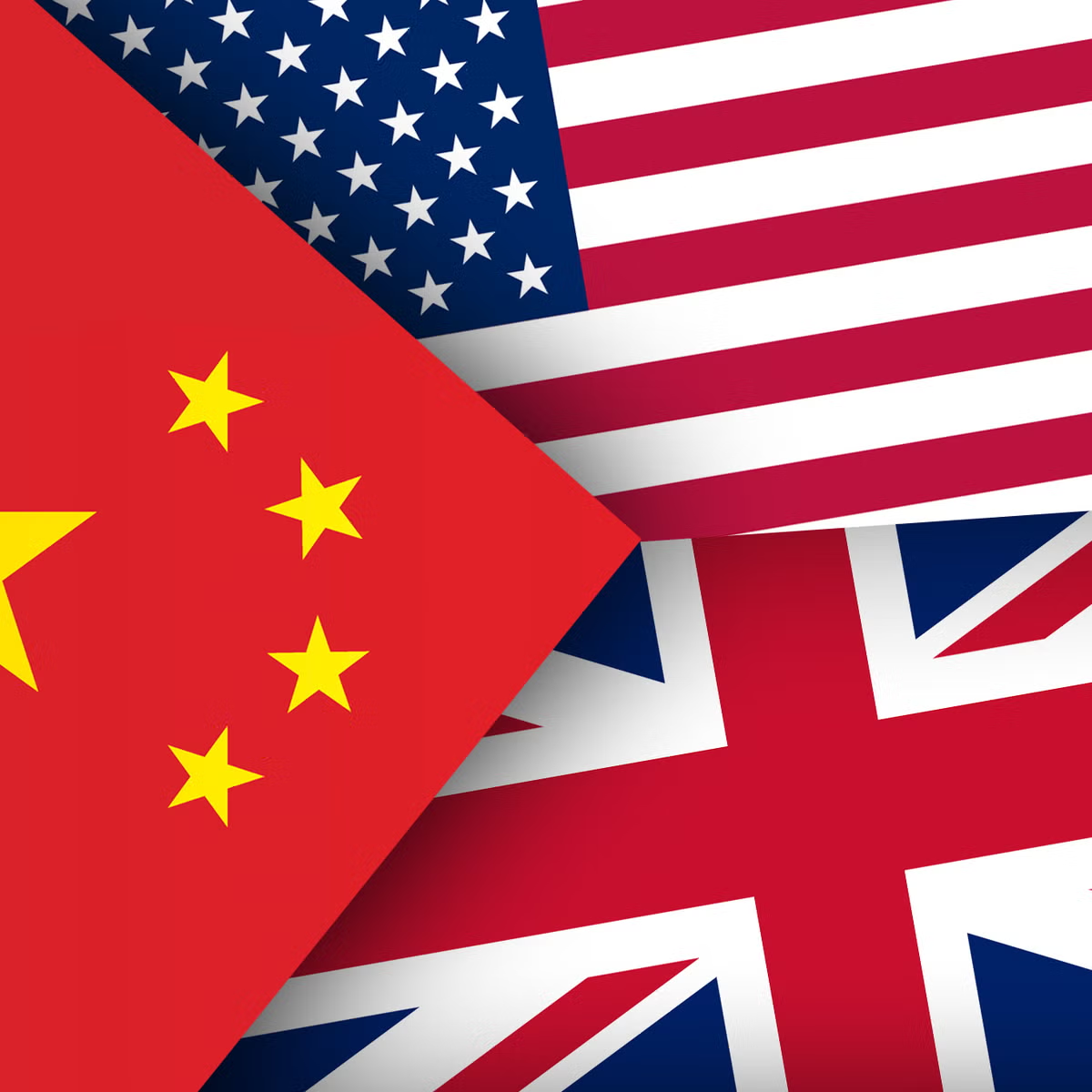
China, Britain, and the United States, despite their very different political and constitutional systems, all maintain mechanisms through which governments can restrict travel or passports when security considerations arise.
China has recently moved further in this direction. New rules give authorities powers to prevent Chinese citizens from leaving the country for up to three years, where they are considered to have harmed national security or national interests while overseas.
The rules also extend to concerns involving industrial and technological security, an increasingly important area as Beijing and Washington compete in strategic sectors such as semiconductors and artificial intelligence.
Chinese authorities have also warned citizens against travelling to destinations considered high-risk.
Restrictions on overseas travel have existed for years among some civil servants and employees of state-owned enterprises, with some workers required to surrender passports and obtain official permission before travelling abroad.
Chinese officials have defended such measures as preventive steps against activities, including fraud, illegal gambling, and other crimes abroad.
Britain provides another important comparison because it demonstrates that passport and citizenship restrictions are not exclusively features of authoritarian systems.
The British Home Secretary has powers to deprive a person of citizenship, where doing so is considered conducive to the public good, including in cases involving national security and counter-terrorism. British citizens can also have passports withheld or withdrawn in specified circumstances.
According to the House of Commons Library, more than 1,500 British citizenship deprivation orders were made between 2010 and 2024, although the majority related to fraud.
There were 223 orders on public-good grounds during that period. The United Kingdom also recorded 100 passport withdrawals for national-security reasons between 2013 and 2024.
The United States similarly has mechanisms for restricting passports. The US Department of State says passports can be denied in circumstances involving valid arrest warrants, court orders, parole or probation conditions, and extradition requests.
American authorities also operate systems allowing law-enforcement agencies to request restrictions on passport issuance.
The United States has also imposed extensive entry and visa restrictions in the name of national security. In January 2026, Washington introduced measures fully or partially suspending entry and visa issuance for nationals of 39 countries, citing security-focused screening and vetting.
That comparison is particularly important in Zambia because a passport is an important document of citizenship and international mobility, but it is not an absolute guarantee that its holder can travel without restriction under every circumstance.
The central question, therefore, is not simply whether Zambia has acted to restrict passports. Governments around the world do so.
China’s increasingly expansive controls, Britain’s established statutory framework, and America’s security-based passport restrictions demonstrate that the tension between individual mobility and national security is not uniquely Zambian.
What ultimately matters is that democracy also has a responsibility to ensure that security powers are safeguarded.


